The director of the library handled my father’s and brothers’ funerals and negotiated with the embalmers. I waited for seventy days for their bodies to be returned. All who knew them judged their lives as virtuous, and I was assured their place in the afterlife was secure.
My father’s wealth paid for each sarcophagus, and I buried them in our family tomb. I sewed what remained of his fortune inside my cloak. With luck I would have ample funds for my travels to Antioch, as well as means for several years if I lived frugally.
When I heardThe Grebes,the largest Roman merchant ship ever to enter our harbors, had docked, I wasted no time.
My father had known the ship’s captain. He once saved the man’s personal books from being confiscated by the library and instead kept the transcribed copies for the library’s collection—something my father was prone to do when he could. He did not agree with the Ptolemies’ edict and believed one of life’s greatest tragedies was for a man to have to part with his books. I hoped the captain would remember my father’s kindness and grant me voyage.

“Of course I remember, girl!” the thick, barrel-chested man bellowed. “Now why are you bothering me?”
Amid the shouts and orders as the ship readied to sail, I spun my tale—that my husband waited for me in Antioch—and added that I was with child, for good measure. The captain looked at my slim frame and frowned but did not question my story.
“Pay your way and stay out of my way, and we’ll have you in Antioch by the week’s end. Now get on. We’ll be leaving shortly.”
“But I need to get my things.”
“Hurry up then. I won’t wait.”
I could tell he would leave me if I wasn’t back in time. I ran home calling on the speed of Hermes.
With no time to consider, I stuffed my bag with every valuable I could seize. First I emptied my mother’s jewelry box. Then I packed her comb, hand mirror, and perfumes, along with my father’s favorite reed pen, a huge stack of parchment, and my brothers’sistrums—percussive instruments used in the festivals. They had no value or use, but I had to take something from each of them. Then I bundled the pottery jar holding the Oracle’s symbols in a swath of silk, along with Ariston’s translation. I laced the gold key on a cord around my neck and tucked it inside my gown. The metal felt cold against my skin.
The library key was now my talisman. Wadjet had chosen me to safeguard her symbols and help them survive. Now all that remained was my set of painted replicas and a translation of her words from a fledgling physician. In my eyes I had already failed.
I ran all the way back to port and boardedThe Grebesonly moments before she pushed off.
The captain saw me dash down the plank and laughed. “I’ve never seen a woman with child run so fast.”
I blushed and hastened to place a hand upon my stomach. The old man chuckled and turned back to his business.
Once on deck, I stood in awe. The ship was massive, bigger than it appeared from the docks. The hull stretched 130 feet long, and the vessel had three masts instead of one to accommodate the tonnage of its cargo. There was a complex system of ropes and knots rigging the square sails; it looked like one of the magical contraptions Ariston’s uncle had crafted.
I walked down the middle of the deck, trying to keep out of the way. One of the ship hands nodded gruffly and motioned “Passengers over there.”
A handful of men clustered in a corner: three scribes, a merchant, two priests, and a Nubian warrior with a goat. I nodded to the motley group with confidence, as if young women traveled alone all the time. Then I took a seat on the bench. The Nubian’s goat came over and nuzzled me.
The warrior surprised me by addressing me. “She smells the spice in your perfume.” He spoke softly.
I looked up at him and nodded, hesitant. Nubians had earned the hard-won reputation of being the fiercest fighters in the world. They were not to be crossed. I decided to let his goat lick my hand as much as the animal wanted.
Among all the merchant ships,The Grebeshad one of the finest reputations—it carried Egypt’s wheat to Rome, wood from Lebanon, oil and wine from Greece, and delivered papyrus throughout the Mediterranean—but still, a week aboard any vessel was a long time. We would travel along the coastline to Antioch, stopping along the way in Damietta, Ascalon, Tyre, and Tripoli to unload cargo, and then finally dock in Seleucia at the mouth of the Orontes River. From there I would take a barge up the river to the city.
The idea of traveling alone both thrilled and terrified me. As the ship pulled away from port, the key hung heavy around my heart. The library shrank smaller with a distance impossible to bridge, for I knew I would never return to Alexandria again.
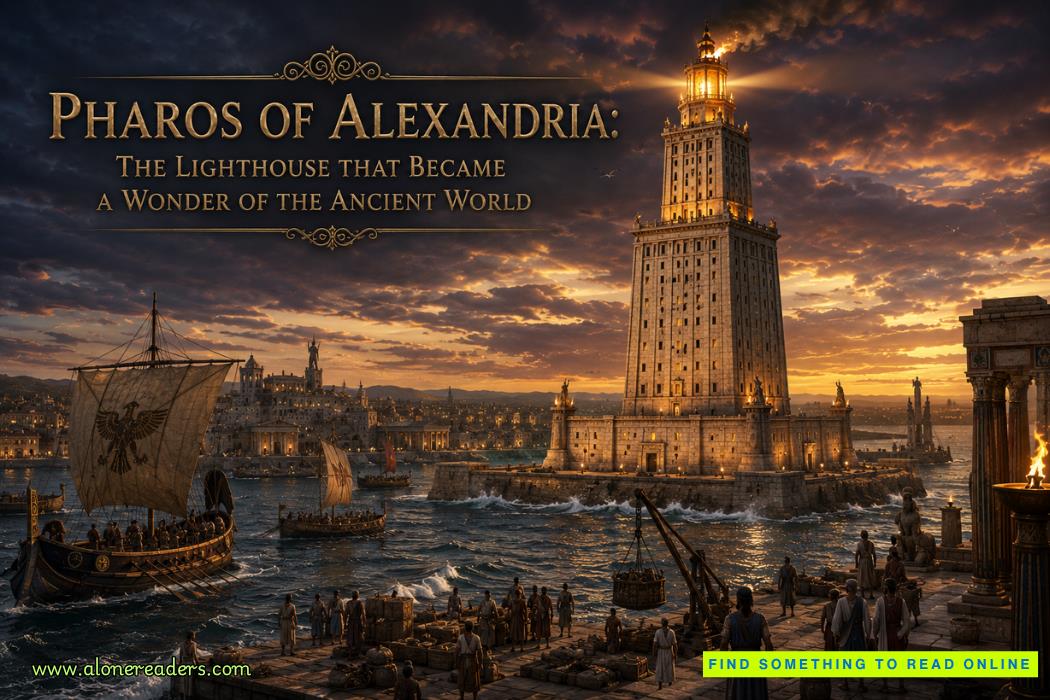
We passed the lighthouse and I forced myself to face the sea.

My old life was behind me, and my one chance at happiness existed in an unknown future. Antioch was a growing metropolis, often called the Rome of the East. I tried to imagine what Ariston’s home was like and began to worry that, in a city of over half a million people, I would never be able to find him at all.
As if the Fates could sense my fear, the voyage seemed doomed by the end of the first day. High winds threatened to batter us into the coastline, and a relentless storm followed overhead, meting out punishing rain and claps of thunder.
Fear took root inside me. What if I died at sea? No one would be there to bury me, and I would never find my way to the afterlife. Shipwrecks were a frequent occurrence, and by the second day all the passengers, everyone except the Nubian, were convinced we would die.
I watched him look out to the water, his stance straight and regal against the rain. Was the warrior unafraid of death, or did he simply know he would not perish on this voyage? I had no such certainty.
***
It was the knife at my neck that woke me.
“Make a sound and you’re dead,” a crewman hissed in my ear as his hand reached under my cloak.