


“Lora,” Rune's voice was soft, deep, and too damn sexy.
“Yes?” I chose a simple black dress. Something casual. I had to go to work in a few hours, but I needed to shower first. I could get into work clothes later.
“Lora.” His hands slid over my bare shoulders, and I shuddered.
“Rune, can you do me a favor and leave?”
His grip tightened.
“I'm sorry. I don't mean that to sound harsh.” I kept my stare on the dress in my hands. “But I like you more than I should. If you don't go now, I'm going to ask you to stay. And we both know that wouldn't be good for us.”
Rune was silent and still. His hands remained locked on my shoulders but didn't even twitch. Finally, they slid away,down my back, trailing over my skin before finally withdrawing. I heard him leave the room. I waited, clutching the dress. A few minutes later, I heard his boots on the stairs. Only then did I crumble to the floor and give in to my tears.
He hadn't said goodbye.
Chapter Six
For me, painting has always been a need, not only a pleasure. I do enjoy it, but it's also integral to my wellbeing. There are times that the need claws at me until I give in. When that happens, I know I won't fully enjoy the process. Because I won't be entirely there for it.
I blinked, refocusing on the canvas before me. It had happened again. I blanked out while painting. Not that I had been possessed or anything like that. Things just go fuzzy around the edges, and I hyper-focus. I go into a sort of daze where my thoughts subside and all there is for me is the drag of the brush through paint. It's like when you're driving and you go on autopilot. You drive and then you seem to wake up when you arrive. You weren't asleep or possessed, you were just driving by route. Automatically. Muscle memory and all that. That's what happens to me, and it's also what makes painting such a great escape. When the need came this time, I welcomed it. I wanted a break from the ache of knowing I'd never see Rune again. But I was shocked at what I'd done.
A man stared back at me from the canvas. Many men actually, but there was only one face that could be clearly seen. He was the only one without a helm, though he wore a full set of armor—English, 1300-1400. That means full plate, chainmaille, gambeson, the whole shebang. He, as well as the men behindhim, were mounted, making it appear to be a huge force. They stretched out to both sides, disappearing off the canvas. But the line was thin, only two horses deep, and beyond them was open land. These were all clues of what battle this was. But the greatest clue was the golden lance the man at the center-front held. It had a thin banner attached to it with two points at the end. The fabric was blood-red and bore a golden flame.
“The Oriflamme,” I whispered. “Holy shit.”
Yes, I know. I painted the damn thing. I should know what battle I was recreating. But, as with my nemesis—who was propped against the wall on my right—I didn't have a plan when I started painting. At least with him, I had that dream to lead me, but this time, there had been nothing. It formed as I painted. And no, that's not normal for me. How odd that this painting came so quickly and with so many details while my nemesis, with its dream inspiration, gave me nothing and refused to let me finish.
As I stared into a pair of world-weary blue eyes, I tried to tell myself it was all the research I'd been doing on armor and battles, trying to spark creativity to finish my nemesis. I'd looked into everything from the Spartan-Persian War to the English Civil War. I was practically an expert now. Well, more of a jack-of-all-trades I suppose. Still, there was a wealth of knowledge in my head that could have subconsciously created this piece. That would be a reasonable explanation.
But I didn't believe it.
The painting was definitely inspired, but it felt as if it came from something beyond me. Again, that's not normal for me, even when I fall into one of my painting trances. I used to joke that I wasn't the artist. Someone painted through me. Butthat was just a joke. I knew I painted everything, even when I was “in the zone.” With this one, however, it wasn't a joke. I certainly wasn't laughing.
“Who are you?” I whispered as I leaned closer to inspect the man. “You can't be French, not in that armor.” I squinted, ignoring his handsome face and windswept dark hair to focus on his gambeson.
The garment was dual-colored, split into four squares of alternating blue and red. The red had gold lions embroidered on it and the blue had fleur de lis.
“Yeah, definitely English,” I murmured. “So, you're an English knight. Important enough to have a horse. And it looks as if you commanded a force of mounted men. But why are you holding the Oriflamme?”
The Oriflamme had been used exclusively by the King of France. Most of the references I'd found to it were from accounts of the Hundred Years War between England and France. When it was raised in battle, it meant that no prisoners were to be taken until it lowered. So why was an English knight holding it?
“And why did I paint you?” I asked him.
With a sigh, I stood up and set my palette down on the little table beside my easel. Absently, I grabbed a rag and started cleaning my brushes. There were three additional paintbrushes on the table, all dirty. Once I had most of the oil paint off them, I headed for the steel bin I used to clean brushes.

Halfway there, I gasped and jerked to a stop, hands clenching around the wooden handles.
There were two more paintings propped on my work table. Only the under-paintings were done—images formed of sepia. But they shocked me for several reasons. First, I didn't remember painting them, much less setting them there. Second, seeing the under-paintings made me realize that I hadn't done an under-painting on the other one. I had gone straight to color. It wasn't completely unheard of for me to do that, but it was odd for me to have done it with one and not the others. Because the third reason I was shocked was the subject of the two additional paintings—more warriors. And both were easily recognizable.
It took only one item for me to recognize the man in the first sepia painting. At least in a general way. Looking closer, I knew I'd leave the background muted, painting it in neutral colors. The Turkish city would likely have been vibrant and full of color, but the composition would require me to focus on the drabness of the stone walls so that the rest of the details would pop. And the man who stood at front and center needed to shine. He had a look about him that shouted valor and zeal. His surcoat would be pure white. No stains to mar it. As white as his kite shield. The only red would appear in the form of two crosses—one on his surcoat and the other on his shield. Although the surcoat was distinctive—a thin, sleeveless tunic as opposed to the padded gambeson worn by English knights in later years—it was the kite shield that immediately identified the knight as not only a crusader but also a templar.
I wouldn't be able to identify him specifically, not by his shield, at least. It was a common and simple design for a templar knight—the cross extending over the entire surface. Nor were there any hints of his identity in his armor, though the addition of plate armor to his chainmaille indicated he was a part of the later crusades. He would have been a monk, living under strict rules. Those rules led to many templar knights rebelling. Theywere known to commit murder (even of their fellow Christians), extortion, and atrocities that rivaled the things done to my people.
But this man looked as if he lived the ideals. There was something holy about him. Surprisingly, there was no one else in the painting, not dead or alive. He was the one warrior of all four paintings who stood completely alone.
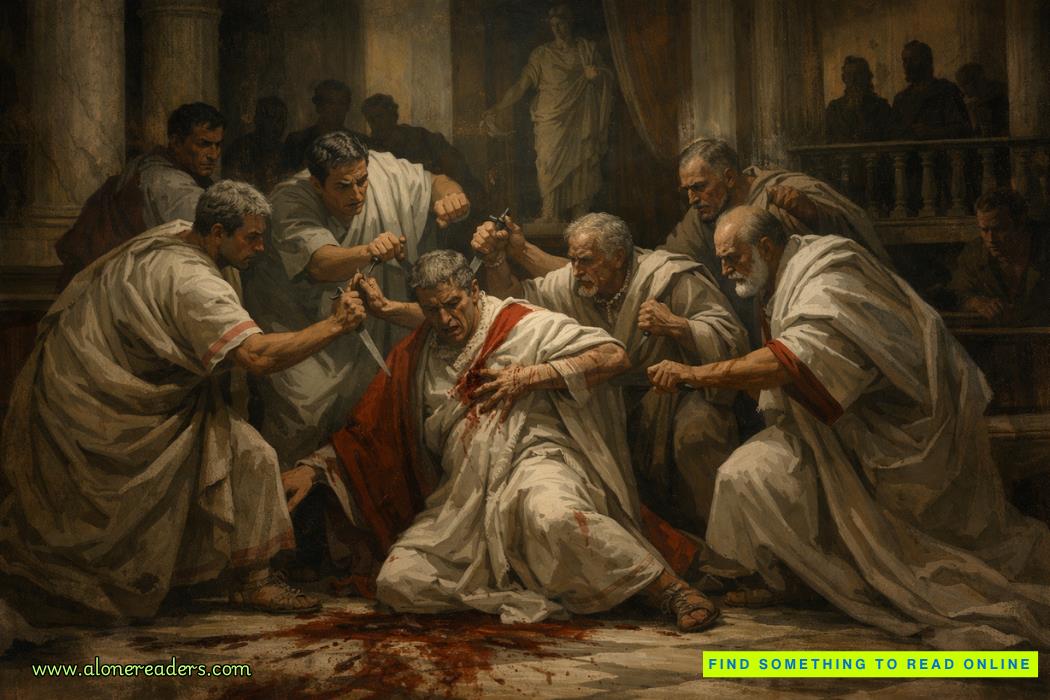
I didn't need armor or banners to give me clues for the second of the sepia paintings. Anyone over the age of sixteen would recognize the scene. It was a gladiatorial event. Granted, I didn't know exactly what arena it was taking place in, but judging from the size of it and those telltale arches, the Colosseum wouldn't be a bad guess.
Just like the rest of them, this painting focused on one man. He stood front-and-center, head lifted with a brutal look on his face. The Roman armor wasn't an automatic indication of his race since even the gladiator slaves were given armor by the Romans. Most of the gladiators were prisoners of war or criminals, but some free men also chose to become gladiators. I didn't think this guy was free. He looked too angry, too weary to have chosen this for himself. A body lay at his feet and he held a sword in his left hand. There was blood all over him. If he had chosen to fight, he would have been grinning in victory, or at least showing some delight through his body language. This man was not delighted.


