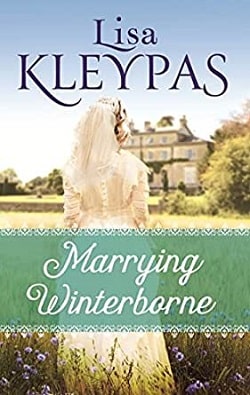
Mary wanted to cry. He did not understand her at all.
It was a fine day to be wed.
The skies had cleared, giving way to a winter sun, and the previous week’s chill had relented; the day was sunny and warm. Mary barely noticed. She was consumed with nervousness as she had been all that night before, for soon she would wear Stephen de Warenne’s ring, soon she would be his lawful wife. She was eager, but she could not help feeling fear. She was about to wed a stranger, to join with him for the rest of her lifetime; she was about to marry her family’s archenemy. Once joined, their union could not be breached; they would remain man and wife until death parted them, despite any and all circumstance. If in the future there was war, how would she survive?
Her knees hurt. The mass was endless, but Mary, so familiar with the ceremony, was barely aware of Archbishop Anselm as he led the congregation. She knelt beside Stephen. He was as still as a statue; he had not moved once since sinking down onto his knees on the floor. Even now, as Mary tilted her head slightly so she could see his hard profile as he bowed his head, he did not even shift. He had not looked at her since she had come up the aisle, escorted by her father.

He was still angry with her for the conversation she had had with Doug, although, had he overheard it all, he would know that she had refused to elope with the Scot. He had barely spoken to her since escorting her from the Tower yesterday. Mary’s stomach was in knots. They would get past this small moment of conflict, of course, but it was a rude way to begin one’s married life, with a coldly distant groom and the threat of never-ending war.
The archbishop bid them rise and join hands. Mary was jerked back to the present. Her knees were stiff, and Stephen’s strength as he helped her up was welcome. She tried to meet his eyes, and was finally rewarded. Their glances held. No matter what ill-placed jealousy he might be feeling, when their gazes collided, something vibrant and powerful sparked between them, something potent and exciting.
Mary was stricken with the urge to tell him many things, to tell him that she would be a good, dutiful, and loyal wife, to tell him that he could trust her, to tell him that she would do her best to ease his life. His gaze was assessing. Mary’s heart wrenched. She would give her right hand to have him trust her wholely and love her in such an unyielding manner.
Vows were made, and finally Stephen placed his ring upon her third finger. The archbishop blessed them, smiling, and Stephen leaned forward to kiss the bride.
Mary strained towards him, dazed, as his lips brushed hers. Stephen moved away, obviously intending only a ceremonial kiss. Mary, on her toes and leaning forward, stumbled against him.
Stephen steadied her. Mary blushed hotly. His eyes were unmistakably warm now. “I am glad you like my kisses so much, madame,” he murmured. “There will be many more, far more bold, in the course of our lifetime.”
Mary held his regard, her pulses skittering, her wits scattered, thrilled.
He escorted her down the long aisle. The crowd, all the greatest Norman and English nobles of the land, cheered. As they exited the church, rye seeds rained down upon them. Mary laughed exultantly. To her surprise, as the rain of seeds became a torrent, Stephen also chuckled.
“With so many seeds, I imagine our union cannot be anything but fecund,” he said.
He still gripped her hand. Mary’s laughter died. His genuine pleasure had lit up his saturnine face, causing her heart to leap uncontrollably. “I hope so, my lord,” she said earnestly.
His own smile died.
Mary’s expression became impish. “After all, my mother had six sons and two daughters. Would that not be enough for you?”
But Stephen was solemn. “Give me one son, Mary, just one son, and I will give you your heart’s fondest desire.”
The wedding celebration was at the Tower in the Great Hall. The hall was overflowing with nobles, overcrowded and stifling warm. Mary and Stephen sat upon the raised dais alone, with King Rufus just below them on one side of the long trestle table, Northumberland on the other. Malcolm was seated after the de Warennes. It was a deliberate insult.
Geoffrey had no appetite. He wondered at his King for humiliating the bride’s father so deliberately, for his never-ending provocation of Malcolm. Fortunately, Malcolm carried no weapons and would not dare to strike out now in his anger, and it was too late for the union to be destroyed. But not too late for the alliance to suffer, he thought grimly, knowing that in a few days they would strike Carlisle.
Geoffrey abruptly rose from his seat, ignoring his father’s inquiring glance. He did not want to watch the bride and groom any longer as they fed each other and gazed cow-eyed at each other. He was not jealous, but he was envious—and he had no right to such an emotion.
Hadn’t he made his choice deliberately?
Geoffrey walked through the performing clowns, passed the dancing girls, and almost stepped upon a small trick dog. He found an empty corner somewhat removed from the press of humanity. He leaned his shoulder against the wall, and unable to help himself, his regard wandered back to the bridal couple upon the dais. Stephen whispered in Mary’s ear. She pinkened and gave her husband an exceedingly bold look.
Geoffrey’s chest ached.




What would it be like, to have such a wife?
He tore his gaze away, angry with himself, and watched the dancing girls. They sought to tease and provoke. He found them attractive, as any man would; they were barely clad, dark-skinned and exotic. Then he saw Adele Beaufort suddenly rise from her seat. His interest in the dancing girls waned. As Adele walked into the crowd of dancing revelers, he lost sight of her briefly.
One single afternoon could not make up for many months of abstinence. But if he dared to identify some of the anguish he carried, he might realize that the gaping wound left behind by his rendezvous could never be healed by sexual indulgence.
Geoffrey did not hate himself. But he despaired. His worldly inclinations were still more powerful than his holy ones. But hadn’t it always been that way?
He had been cloistered with monks at St. Augustine’s from the age of thirteen for three long years, and as a novitiate he had taken vows of chastity, among many others. But he had been young, his blood hot, and he had been unable to uphold his vows—unwilling to uphold them. Fortunately there were no opportunities to chase the fairer sex in a monastery, but at night, alone and in bed, he had engaged in the loneliest, lowest sexual act a man could. The few times he had left the cloister on Church affairs, always with Lanfranc, he had stolen away in the night and lifted whatever skirts he could find. Guilt had been a heavy cross to bear, and Geoffrey had been certain that his mentor always knew of his midnight excursions. But Lanfranc had never lost faith in him. Somehow Geoffrey kept faith in himself, too.
His will was now a man’s and far stronger than that of an adolescent boy’s. He abstained for long periods of time. Until the yearning of his flesh overrode all his holy intentions. But—he was not ordained. Most archdeacons were ordained priests. Certainly all bishops were—even if the ordination was merely a ceremonial show.
If such an appointment came, he would have achieved a lifelong ambition.